
The Manager Who Rewrites the Strategy

I lived this one. You sit in the all-hands, you hear the strategy straight from the top, and it makes sense. Then you go back to your team, and your manager stands up and explains what it "really" means. Except the version they describe is not the strategy. It is their strategy. Their read, their priorities, their beliefs about what actually matters, wrapped in the language of the company's plan. And from that moment, your team is executing something the executives never approved.
It is one of the most disorienting things you can experience as an employee. You can see both versions at once. You know what leadership said. You watch it get bent in real time. And you have almost no standing to say so.
Here is why this is not a rare personality problem. Sull and his colleagues studied more than 8,000 managers across 250-plus companies and found that only half of middle managers can name even one of their company's top five priorities. HALF. If the layer responsible for translating strategy into daily work cannot articulate what the strategy is, then reinterpretation is not the exception. It is the default. The strategy being executed on the ground necessarily diverges from the strategy approved at the top, and the divergence grows at every level it passes through.
The manager is not usually acting in bad faith. They are filling a vacuum. When strategy arrives vague, when priorities are not ranked, when nobody said out loud what to stop doing, a manager does the human thing: they resolve the ambiguity using their own judgment and their own agenda. Sometimes that agenda is protecting their team. Sometimes it is their pet project. Sometimes it is just what they have always believed good work looks like. The result is the same.
The team gets a private strategy dressed as the public one.
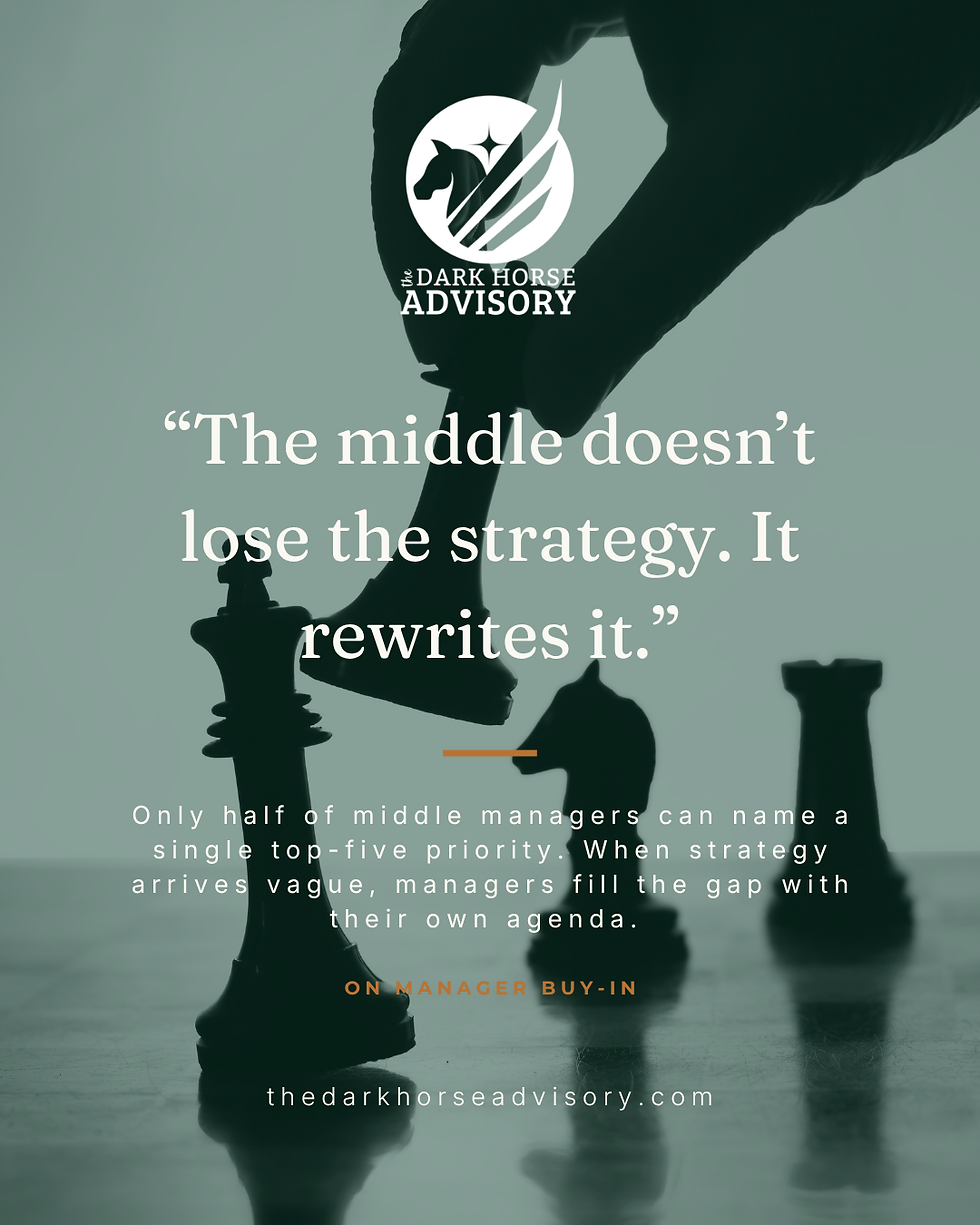
This is exactly why buy-in is not a soft nicety. It is the mechanism. A manager who genuinely understands and agrees with the strategy becomes a force multiplier. They create clarity where there was fog, momentum where there was drift, and accountability that people trust because it is consistent with what leadership actually asked for. A manager who does not have buy-in becomes a leak, and every person under them inherits the distortion.
So what changes this? Three things, and none of them is a better email.
First, make managers translate the strategy back to you before they carry it down. If a manager cannot state the top priorities and what the team will stop doing, in their own words, they are not ready to lead the execution of it. That gap is findable in one conversation.
Second, close the loop with the layer below. The fastest way to catch a hijacked strategy is to ask the people doing the work what they think they are executing and why. When their answer does not match the executive intent, you have found your leak, and it is almost never the frontline's fault.
Third, give managers real input before the strategy is set, not just the job of selling it after. People carry what they helped build. A manager who was consulted defends the strategy. A manager who was handed it defends themselves.
The middle is where strategy becomes work. Get buy-in there and the manager multiplies your intent. Skip it and the manager quietly replaces it.
Most teams do not have a strategy problem. They have an execution problem. The plan is sound, the offsite went well, everyone agreed. Then the work stalls. Not because people do not care, but because ownership is fuzzy, decisions get stuck, and follow-through is invisible.
For mid-level managers it is harder still. You are accountable for outcomes you do not fully control, executing a strategy you did not write, across a team that may be spread over three time zones. That is not a motivation problem. It is a structure problem, and structure is fixable.
Learn more about how The Dark Horse Advisory can help your team with The Execution Reset.

Comments